Social guide / NF 005
Talking to strangers at an izakaya:friendly, awkward or rude?
A lively room can make conversation feel natural—but friendliness depends on where you sit, how you open and whether interest is mutual.
Evidence label / Official visitor guidance • Alcohol and transport rules • Practical etiquette
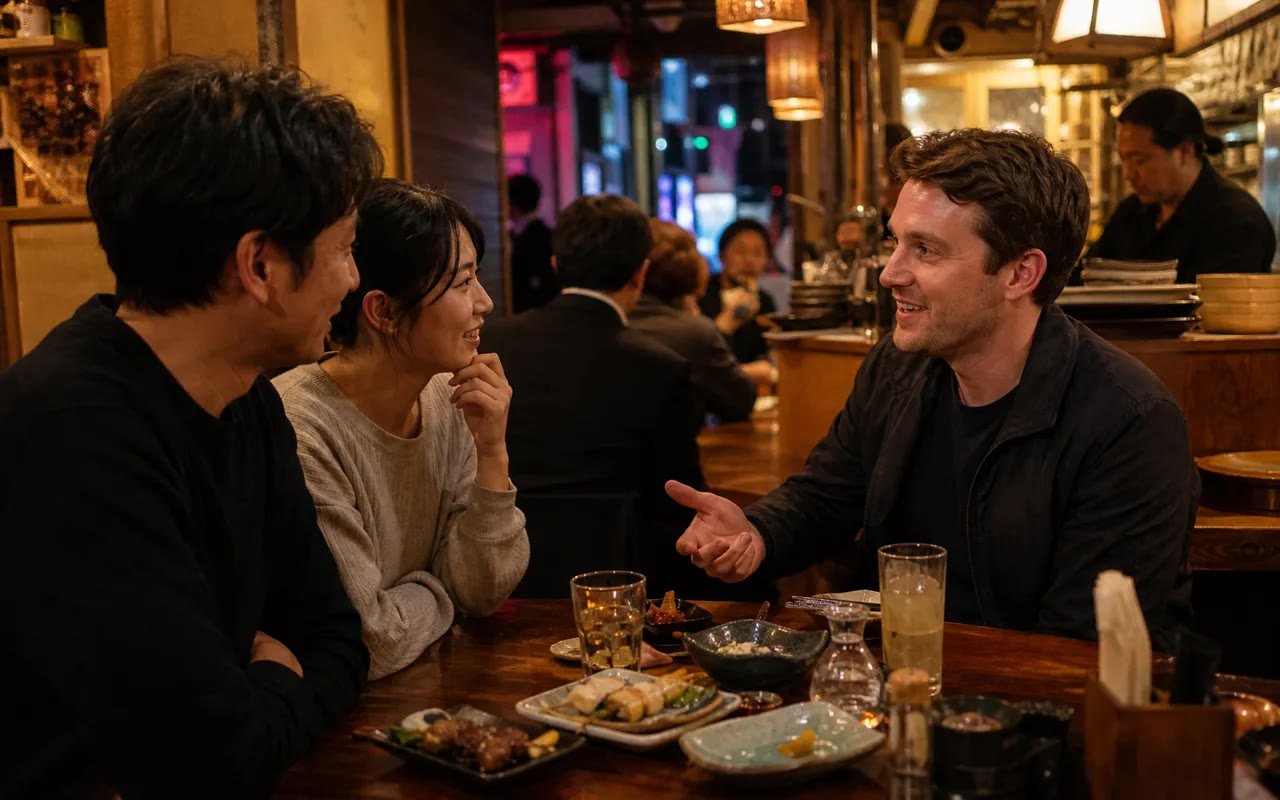
An izakaya can feel like the perfect place to meet people in Japan: plates are shared, voices are louder than in a quiet restaurant, and the person beside you may be ordering something unfamiliar. But a lively room is not an open invitation.
Read the room before saying hello
Start with the layout. A counter, standing bar or tiny yokocho pub naturally puts customers in one another’s orbit. A private booth, partitioned table or closed circle of coworkers usually signals the opposite. Shared dishes are shared by the group that ordered them—not by the whole room.
Look for a low-stakes opening: brief eye contact, a returned smile, or a comment that arises naturally because you are seated close together. Do not interrupt a serious conversation, lean across someone’s table or make a group rearrange itself for you.
Open with the place, not the person
A situational question is safer than a personal compliment. Try Kore wa nan desu ka? (“What is this?”), Oishii desu ne (“It’s good, isn’t it?”), or Kono hen de osusume wa arimasu ka? (“What do you recommend around here?”). Even a simple Konbanwa may be enough.
Ask once, then pause. A smile and short answer means: say thank you and return to your drink. A question back, turned body or continued topic means there is reciprocity—for the moment, not automatically for the rest of the night.
Avoid opening with nationality, relationship status, age, someone’s body, or stereotypes about Japanese women or men. Start with names, food, the neighborhood, travel or music: ordinary subjects between ordinary adults.
Keep staff out of your social strategy
Use staff attention for service, not to ask employees to introduce you to another customer, reveal personal information or decide whether someone “likes foreigners.” Understand that an automatic otoshi appetizer may function as a table charge, and confirm orders and payment before moving seats or sharing anything.
Alcohol never supplies consent
Japan’s drinking culture can be sociable, and nomihodai plans make refills easy. Neither changes the rules of consent. Drinking alcohol under 20 is prohibited. Do not pressure someone to keep pace, secretly top up a glass, or frame a purchased drink as creating an obligation.
Do not initiate physical contact, photograph a stranger or post their image without a clear yes. Treat increasing intoxication as a reason to slow down, not an opportunity. A slurred yes, passive compliance or failure to object is not meaningful consent. If someone is heavily intoxicated, involve their friends or venue staff.
A good opener creates a small opening. It never turns politeness into an obligation.
Know the graceful exit
Closed answers, repeatedly checking a phone, turning back to companions, little eye contact or no questions in return all mean: wrap up. Say Arigato gozaimasu. Ja, shitsurei shimasu—“Thank you. I’ll leave you to it”—and give them space.
Do not ask again after another round. Do not follow someone to the smoking area, restroom corridor, next bar or station. If contact details come up mutually, offer yours once instead of taking their phone and entering it yourself.
Talking to strangers at an izakaya is not inherently rude. In the right seat, with a light opener and reciprocal interest, it can be a pleasure. The goal is not to “break through” Japanese reserve; it is to make it completely safe to join—or leave—the conversation.
This article distinguishes verified facts from interpretation and practical advice. It does not claim to represent every person in Japan.
Continue by topic
More Tokyo nightlife guides