Women & culture / NF 007
Why women-only train cars existand what visitors should know
Women-only cars are a response to harassment, not a judgment on every male passenger. Here is how to read the signs and handle a mistake.
Evidence label / Operator rules • Transport policy • Police safety guidance
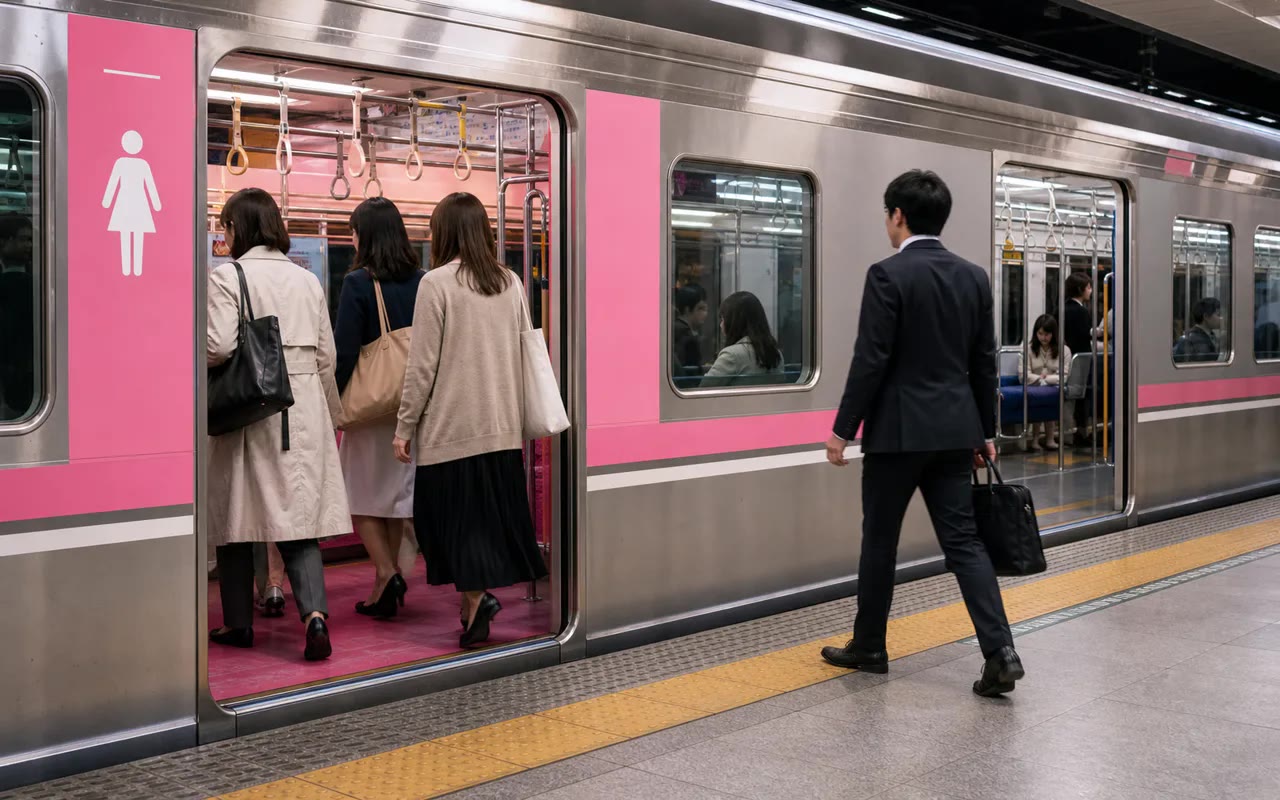
You hurry onto a commuter train, then notice pink platform markings and the words “Women Only.” Is the car permanently restricted? What if you already stepped aboard?
The useful answer is simple: check the sign, follow the operator’s request and move calmly if you boarded the wrong car. Rules differ by line, direction and time—and the system is not a referendum on what all Japanese women think about men.
Why the cars exist
The immediate background is chikan: groping and other sexual offenses, especially on crowded trains. Japan’s transport ministry studied the measure in the early 2000s after finding demand for women-only cars as a countermeasure. Operators then adopted the system in different forms.
This is not merely an etiquette story. Tokyo police treats groping as a serious crime and urges victims and bystanders to seek help. Women-only cars provide one option alongside policing, station reporting and prevention campaigns; they do not make ordinary cars someone else’s problem.
Not every line, train or hour
There is no single national timetable. Tokyo Metro says designated cars operate during the morning rush, from the first train until around 9:30 a.m., with times varying by line and operation. JR East’s information is more granular: car number, direction and applicable time differ by line. Through-services and disruption can change operation.
Before boarding, check platform floor markings, overhead signs and stickers beside the doors. Look for the car number, direction and hours. Listen for announcements. Do not rely only on the color pink.
Who may use them?
Operator guidance includes more than adult women. Tokyo Metro permits elementary-school-age and younger children, passengers with physical or mental disabilities and caregivers. JR East also lists children, passengers with disabilities and male caregivers under its stated conditions.
Visitors do not need to inspect who “belongs.” A person’s disability, age, gender or role may not be obvious. The sign guides your own boarding decision; it is not permission to interrogate another passenger.
If you board by mistake
For a male visitor, an accidental step aboard is a navigation error—not a moment for debate. If the doors remain safely open, step back and enter the next car. Never hold or force doors. If the train is moving or too crowded to change safely, wait until the next station and move along the platform.
Sumimasen, machigaemashita—“Sorry, I made a mistake”—is enough if someone alerts you. Do not make passengers reassure you, film the exchange or argue about fairness. When uncertain whether the designation is active, ask station staff.
Read the local sign. Follow the request. Move without drama.
What to do about harassment
Do not treat chikan as a cultural curiosity or joke. Keep hands visible in dense crowds, respect space as far as conditions allow and never use crowding as an excuse for contact.
If someone appears to ask for help, say Daijobu desu ka?—“Are you okay?”—help create space and alert staff. Tokyo police asks bystanders not to remain passive and advises victims to make noise, seek nearby help and call 110 promptly. Avoid a solo confrontation that could increase danger; prioritize the affected person’s wishes and immediate safety.
Do not turn policy into a theory about women
Some women value these cars, some do not use them, and some criticize how the system works. The existence of the car tells you operators and agencies recognize a safety problem and offer a designated space. It tells you nothing about whether an individual woman fears men, supports every detail or wants to discuss it with a foreign visitor.
This article distinguishes verified facts from interpretation and practical advice. It does not claim to represent every person in Japan.
Continue by topic
More Japan etiquette guides