Social guide / NF 032
Meeting your Japanese partner’s friends: hug, handshake or bow?Start with a greeting that leaves room for their preference
A first introduction need not become an etiquette test. Use a small greeting, notice the person in front of you and ask your partner when unsure.
Evidence label / JNTO etiquette guidance • Practical first-meeting advice • No universal dating rule
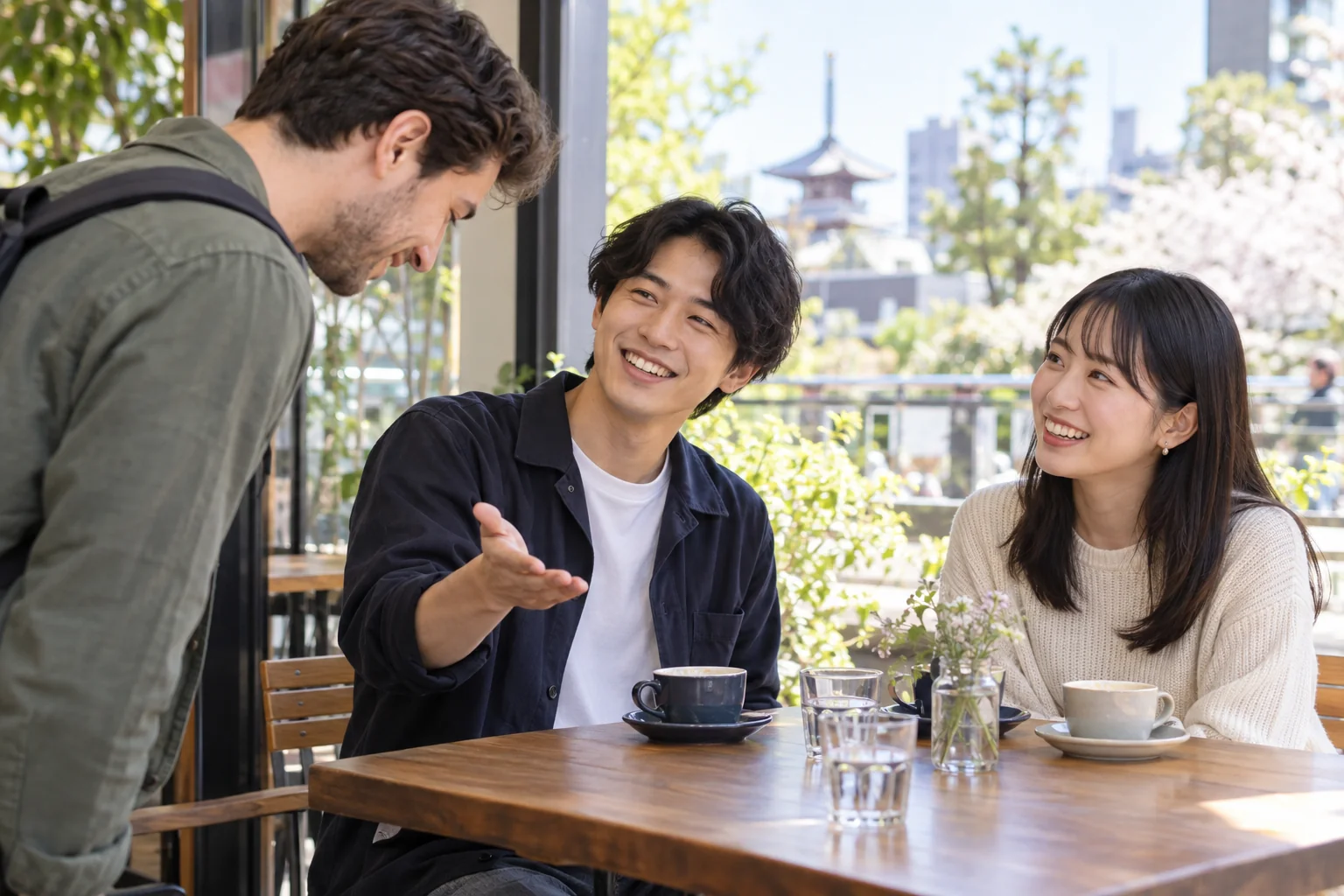
You are about to meet your partner’s friends at a cafe. Should you lean in for a hug, offer a hand or bow? There is no single move that fits every person or every group. A warm verbal greeting and a small bow give everyone room to choose how familiar to be.
The Japan National Tourism Organization (JNTO) says that body contact is generally less common in everyday Japanese greetings, while also saying it is not forbidden. It suggests watching how people interact and notes that a polite bow works in most situations. That is travel guidance, not a survey of how your particular partner’s friends want to greet you.
Before you meet, ask your partner about this group
Our practical suggestion is to ask one ordinary question beforehand: ‘How do your friends usually say hello?’ A long etiquette briefing is unnecessary. Your partner may know that someone enjoys handshakes, that this group barely bows, or that the meeting is a relaxed coffee rather than a formal introduction. Those personal details are more useful than guessing from nationality.
Check names and the place too. If you are entering a crowded cafe, focus first on recognizing the people and getting out of the doorway. A greeting can happen once everyone has space. You do not need to rehearse a deep bow or a perfect Japanese sentence to show respect.
At the introduction, keep the first move easy to read
Smile, say your name and ‘nice to meet you,’ and make a slight bow or nod. Leave enough space for the other person to answer in their own way. If they offer a handshake, you can accept it. If they initiate a hug and you are comfortable, you can reciprocate. You can also politely decline contact you do not want. None of these choices can be read reliably as a measure of romantic or social approval.
JNTO also lists ‘yoroshiku onegaishimasu’ as a phrase you may hear when meeting someone. You can use it if you know it, but an understandable greeting in the language you share is better than performing a phrase whose meaning you cannot explain. Ask your partner for help if names or introductions move too quickly.
A small greeting can open the conversation without deciding everyone’s comfort with touch.
After hello, make room for an actual conversation
A greeting lasts seconds; the rest of the visit is about getting to know people. Ask an open question about a shared interest or the cafe, listen to the answer and give others time to speak. If the group switches languages, ask for a quick summary when you need one. That request is about understanding the conversation, not demanding that everyone change their habits for you.
If you misread a cue, a brief ‘sorry’ or ‘I was not sure how to greet you’ is enough. Do not turn one awkward bow into a long explanation about Japanese culture. Follow the other person’s lead from there. These are editorial suggestions for a low-pressure first meeting; the JNTO source does not prescribe a script for meeting a partner’s friends.
Common misunderstanding: a bow means distance, a hug means closeness
A greeting style alone cannot tell you what someone thinks of you. People differ in comfort with touch, and the same person may greet close friends and new acquaintances differently. Your partner’s relationship with a friend does not automatically set your own level of familiarity with that friend.
The official guide describes broad visitor etiquette; it does not measure dating outcomes, define a national rule for friends, or tell you whether a particular gesture signals acceptance. Use its small-bow advice as a starting point, then let the people you meet show you their preferences.
Keep reading
JNTO guidance checked September 24, 2026. It describes general everyday interactions, not a rule for an individual friend group or evidence about attraction. Practical steps are Neon Footnotes editorial advice. The image shows fictional adults and is AI-generated.
Continue by topic
More Dating in Japan guides