Social guide / NF 034
Do you need to reserve space for a large suitcase on the Shinkansen?Measure three sides before you choose your seat
On the Tokaido, Sanyo, Kyushu and Nishi Kyushu Shinkansen, a suitcase over 160 cm across three sides needs a designated seat reservation.
Evidence label / JR Central baggage rules • Visitor booking checklist • Line-specific limits
A large suitcase can turn a simple train booking into a last-minute problem. On the Tokaido, Sanyo, Kyushu and Nishi Kyushu Shinkansen, the question is its size: add its height, width and depth. If that total is over 160 cm and no more than 250 cm, arrange a seat with an oversized-baggage area before boarding.
These are JR Central’s published rules for those Shinkansen lines, checked September 29, 2026. Other rail operators may use different arrangements; check the operator for each leg of your journey.
1. Measure the suitcase, not its airline label
Add the three outside dimensions in centimetres. For example, a case measuring 78 × 52 × 34 cm totals 164 cm, so it falls above the 160 cm threshold. A case totalling exactly 160 cm does not cross that threshold. JR Central says baggage over 250 cm in total cannot be brought on board.
For bags at or below 160 cm, the oversized-baggage reservation is not required. JR Central points to the overhead rack, footwell or deck storage, depending on the bag. A heavy or awkward case can still be difficult to lift; the operator recommends booking suitable space when your bag would be hard to store near your seat.
2. Select the baggage seat while booking
For an oversized case, select “Seat with an oversized baggage area” in an eligible online booking or reserved-seat ticket machine, or ask at a JR ticket office. JR Central says the designated seat costs the same as an ordinary reserved seat in the same class; there is no extra charge for the baggage-space reservation itself.
Do not assume an unreserved seat gives you access to the space behind the last row. JR Central says that space belongs to passengers who reserved the matching seats. Some trains and cars have no such seats, and availability can sell out. If the right seat is unavailable, look for another train before you travel.
Measure first, then book the seat that actually includes the baggage space.
3. If your plan changes, fix the reservation first
If you change trains or miss a booked departure, do not simply board the next non-reserved car with an oversized case. JR Central says to change the booking before boarding or obtain a new appropriate reserved-seat ticket for the next train. Ask station staff which option applies to your ticket.
The operator lists a ¥1,000 carry-on fee for bringing oversized baggage without the reservation and says staff may direct you to a designated storage place. Payment is not a guaranteed way to board any train: when suitable space is full, staff may ask you to reserve another service. Reserve early if your schedule is tight.
Common mistake: every bulky item follows the suitcase rule
JR Central distinguishes suitcases from strollers, sports equipment and musical instruments. Those items can generally be brought without the oversized-baggage reservation, but you still need the designated seat if you want to use its reserved space. Check the operator’s current guidance for your exact item and line.
The 160 cm test is a rule for the named Shinkansen services, not a universal rule for every train in Japan. Our practical checklist is to measure the case, identify the operator and train, reserve the correct seat when required, and keep the booking details handy at the station.
Keep reading
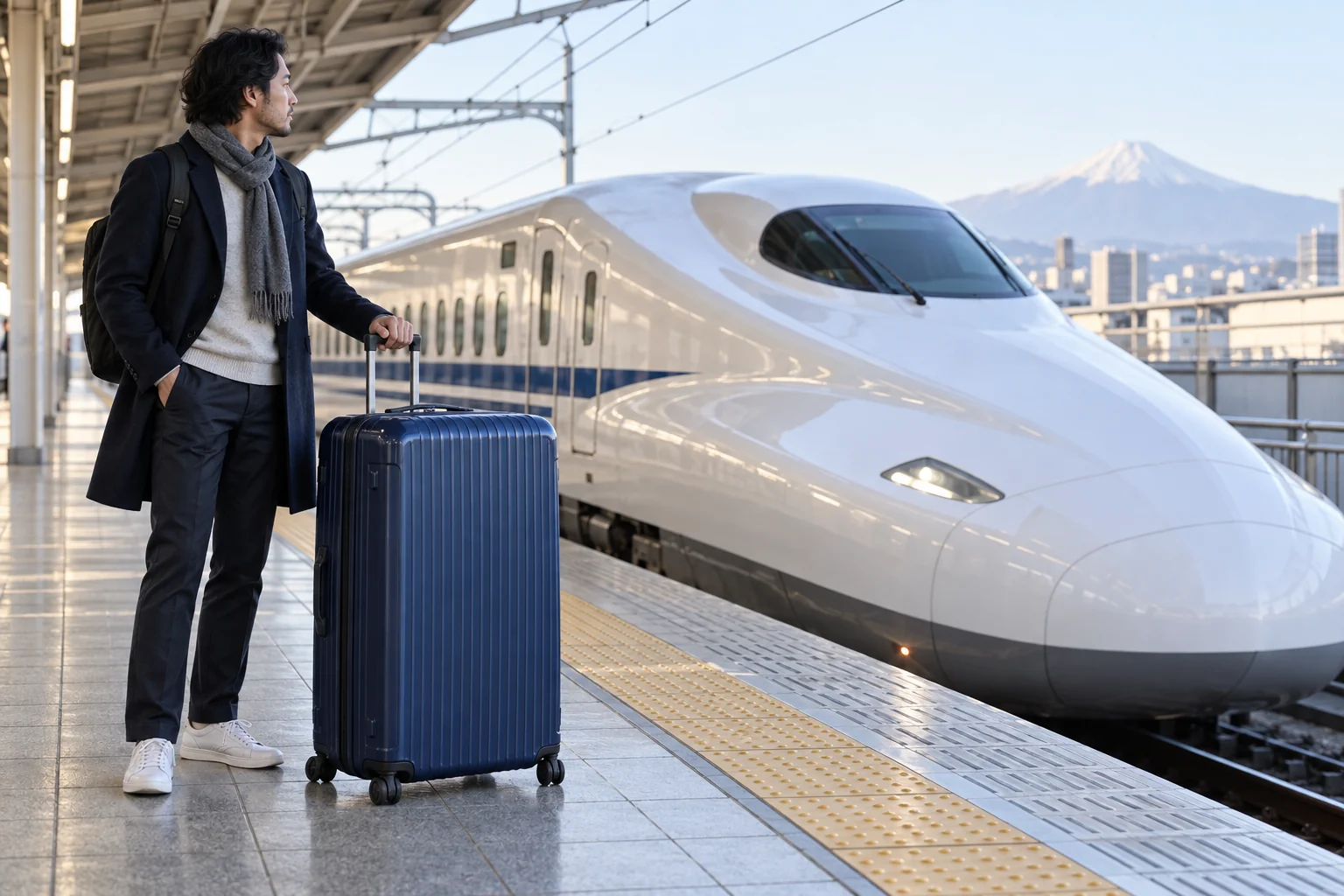
JR Central’s official English guidance checked September 29, 2026. The example measurement and booking checklist are editorial explanations of its rules. Conditions depend on line, seat and ticket; consult the current operator information before travel. The train-platform scene is fictional and AI-generated, not a photograph of a particular train or station.
Continue by topic
More Japan etiquette guides