Social guide / NF 038
Can two people use one Suica card on trains?Plan one valid card or ticket for each traveler
For a shared train journey, each traveler needs a valid card or ticket. Learn why double-tapping one Suica fails and how a named bus exception differs.
Evidence label / JR East IC rules • Gate troubleshooting • Toei bus payment procedure
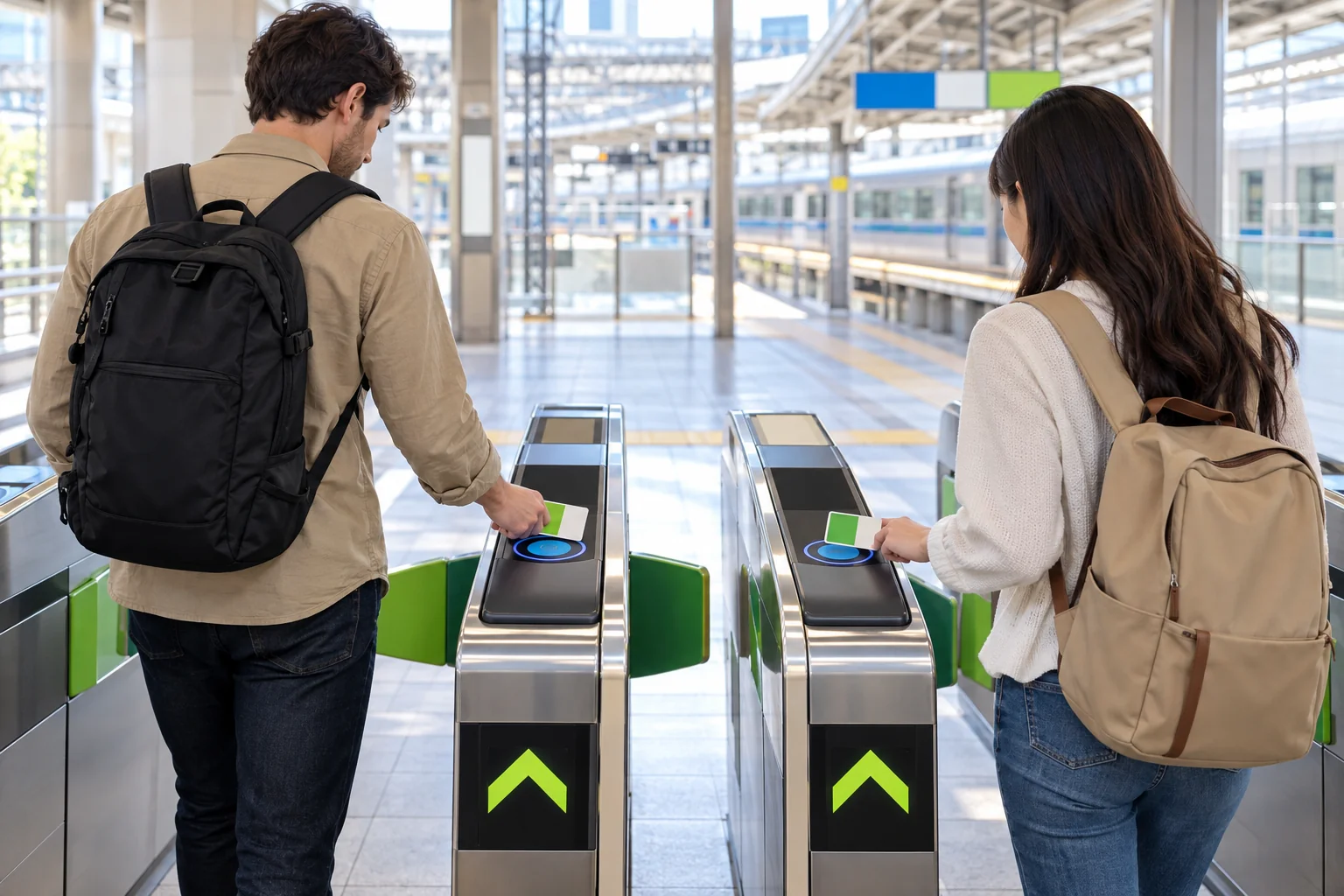
No—for two people making the same railway journey, one Suica is not a group ticket. Loading enough money for both fares does not make it possible to send the card back through the barrier for a second passenger.
This matters when a couple or group reaches its first station with one shared travel budget. The money question and the passenger question are separate. Plan a valid card or ticket for each traveler before anyone goes through, then keep that person's travel medium with them until the journey is finished.
Why a second tap does not buy a second train journey
JR East's IC Card Ticket Handling Rules, effective March 14, 2026, make a Suica fare card valid for one person on one one-way ride. They also require the same IC card to be checked at entry and exit. A card with an unfinished entry cannot simply start another entry.
Think of the gate as recording a journey, not taking two separate retail payments. After one person enters, passing that card back does not turn it into the second person's ticket. Our planning rule is straightforward: one traveler, one valid travel medium, from entry through exit.
A two-person checklist before the barrier
First, check the route and which ticket products the railway accepts. The choice may be a compatible IC card or another valid ticket offered by that operator. You do not both have to use the same product merely because you are traveling together.
Next, make sure each traveler has their own accepted card or ticket ready. If the plan is to use IC balance, check that person's card balance too. JR East's English Suica guide explains that the fare is calculated at the destination and an insufficient balance needs topping up. Enough money on your companion's card does not fix your own card's balance.
Finally, agree where to meet if one person is held up. Our suggestion is to solve a missing-ticket problem on the public side of the gates, where you can still speak to staff together. For children or special ticket products, check the operator's eligibility rules separately rather than treating an adult example as a universal fare rule.
A shared travel budget is not a shared railway ticket.
If one person has already gone through
Stop trying to improvise with the same card and ask the staffed gate or intercom for help. JR East's gate-troubleshooting guide explains that a card with an existing entry record can be refused on fresh entry; a missing entry record can also prevent exit settlement.
Explain what actually happened: two passengers, one card, and whether either person has already tapped in. An English sentence such as “We are two passengers, but we have only one card” is more useful than silently presenting the card over and over. Show staff the card involved and follow their instructions.
If you entered using an IC card, keep using that same card to finish the journey. Do not swap travel media with your companion midway and assume the exit gate can reconstruct your plan. The staff response depends on the journey and ticket situation; this guide does not promise a particular adjustment or fee.
Buses can have a different payment procedure
Do not turn the railway answer into “one IC card can never pay for more than one person.” Tokyo's Toei bus guidance describes payment for multiple passengers after telling the driver before tapping. The driver sets up the transaction; repeatedly tapping the card for another passenger is not the stated procedure.
This is a named operator's bus payment arrangement, not permission to share a card at railway gates. Ask the bus operator about its current method before boarding, particularly if different fare categories are involved. Do not assume every bus company, route or ticket product uses the Toei procedure.
Balance, ownership and booking are separate checks
More stored money does not create another passenger's railway ticket. A card registered to a person also has user restrictions: JR East's rules restrict a registered IC card to its registered user. Do not treat it as an anonymous card to hand around.
For a Shinkansen journey, check the booking method separately. Our related Shinkansen guide explains the difference between a card, a booking and balance payment. Getting the ordinary-train arrangement right does not by itself establish that your card is ready for a reserved bullet-train journey.
Evidence and limits
Sources were checked on October 13, 2026. This guide addresses shared railway journeys using Suica, with a specifically identified Toei bus contrast. It is not a guide to every fare product, mobile-wallet configuration, child's fare or IC acceptance area. Operator sources establish the rules and troubleshooting routes; the group-planning checklist and communication suggestions are our editorial advice.
Keep reading
Primary operator sources checked October 13, 2026, including JR East's English IC rules effective March 14, 2026. The bus contrast is specific to the cited Toei guidance; check the operator and ticket product for your journey. Practical group-planning and communication advice is editorial. The image is an AI-generated fictional scene, not a photograph of a particular station, card product or traveler.
Continue by topic
More Japan etiquette guides