Social guide / NF 036
Can you use Suica for the Shinkansen?A card, a booking and a balance are different things
Yes, with a correctly linked booking or an eligible Touch de Go journey. Topping up alone is not a ticket for every bullet train.
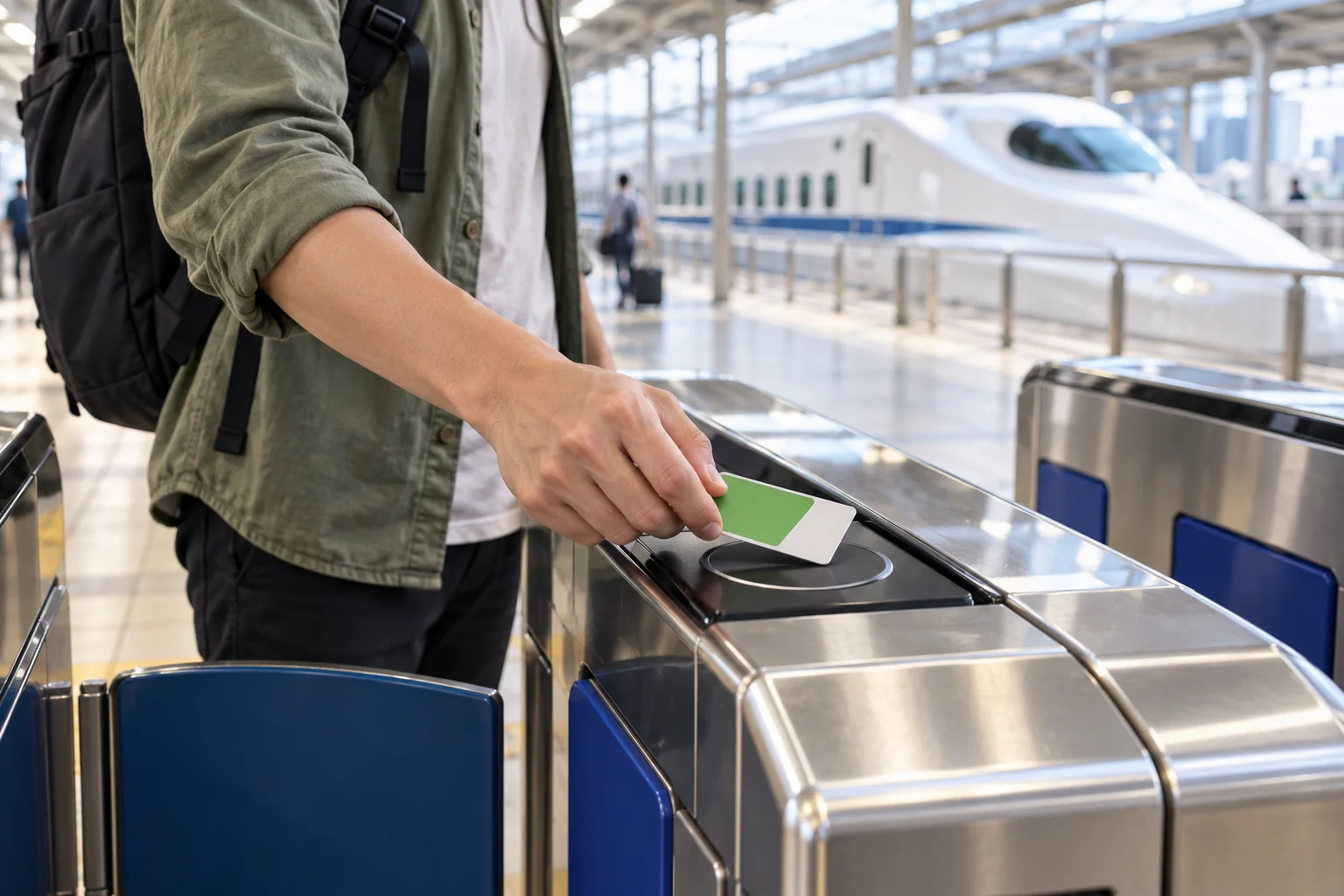
Evidence label / smartEX boarding guidance • JR East Touch de Go rules • Check your booking method
You have charged your Suica and reached the Shinkansen gate. Can you tap through? Sometimes—but the balance on the card and permission to take that train are different questions. An IC card can identify a purchased booking, while a separate service may deduct an eligible journey from its balance.
The useful answer is not “Suica never works” or “Suica works everywhere.” First identify the line and the ticketing service. The same tap can mean different things under different rules.
For smartEX, link the card to a purchased booking
smartEX covers the Tokaido, Sanyo and Kyushu Shinkansen. Its official guide allows boarding with a QR-Ticket, collected paper tickets, or a registered and designated transport IC card. For IC boarding, the Shinkansen fare is paid from the registered credit card at reservation; it is not deducted from your Suica balance. Adding money to Suica does not create that booking.
Check the reservation details and the IC card designated for it before leaving for the station. smartEX lets you designate the card through the reservation-complete or reservation-details screen. A round trip needs designation for both directions, and one card cannot be designated for multiple seats in a single reservation. Do not assume saving a card somewhere is the same as assigning it to this journey.
At the gate, use the designated card and keep the seat slip
For smartEX IC boarding, touch the designated card at the Shinkansen gate and collect the printed Seat Information. That slip identifies the journey and seat; it cannot be used to open the gate. If you reach the Shinkansen by an ordinary train, that ordinary-train fare is separate and can be deducted from the IC balance.
The smartEX guide also warns that passing through an ordinary-line concourse can require a minimum IC balance even when no concourse fare is deducted. If combining a paper ordinary-train ticket with the designated IC card, insert the paper ticket first, then tap. These are smartEX instructions for that combination, not a universal sequence for every ticket product.
Know what the tap represents: a linked booking or an eligible balance-paid journey.
JR East has a limited balance-payment exception
JR East’s Touch de Go! Shinkansen permits balance payment on eligible journeys within its specified area. Ordinary compatible IC cards need initial service registration. Welcome Suica Mobile has a different rule: its English guide says no Touch de Go start-up registration is required, and the eligible Shinkansen fare is deducted from the balance on exit.
This is not a nationwide replacement for a Shinkansen ticket or a seat reservation. Check the exact route and train in the operator’s operating-area and restrictions guide. The service mainly concerns non-reserved seating, with specific vacant-seat rules on some trains with all reserved seats. If using a vacant reserved seat under those rules, yield it to a passenger with that seat reservation. Do not carry this exception over to a Tokyo–Kyoto Tokaido Shinkansen journey, or assume every JR East itinerary qualifies.
Before you tap, make a three-part check
Our planning checklist is: identify the route, identify the boarding method, and check the correct card or device. For a booking, confirm the train/date and its IC assignment. For Touch de Go, confirm the service is enabled where required, the journey is eligible and the balance is sufficient. Keep the operator’s instructions available rather than guessing at a busy gate.
A common mistake is treating “ticketless” as “no ticket purchase or conditions.” It describes how you enter, not a promise that every fare comes from stored value. smartEX offers QR-Ticket or paper-ticket alternatives when an IC card is not registered or designated. If your method is unclear, pause and ask station staff before tapping; that last step is our practical advice.
Keep reading
Operator guidance checked October 6, 2026. smartEX and JR East Touch de Go are separate systems with route, train and card conditions. This guide explains the distinction, not every fare product or transfer. The planning checklist is Neon Footnotes editorial advice. The AI image depicts a fictional adult, generic card, gate and train, not an exact station or an official product photograph.
Continue by topic
More Japan etiquette guides